What are the characteristics of a catamaran hull?
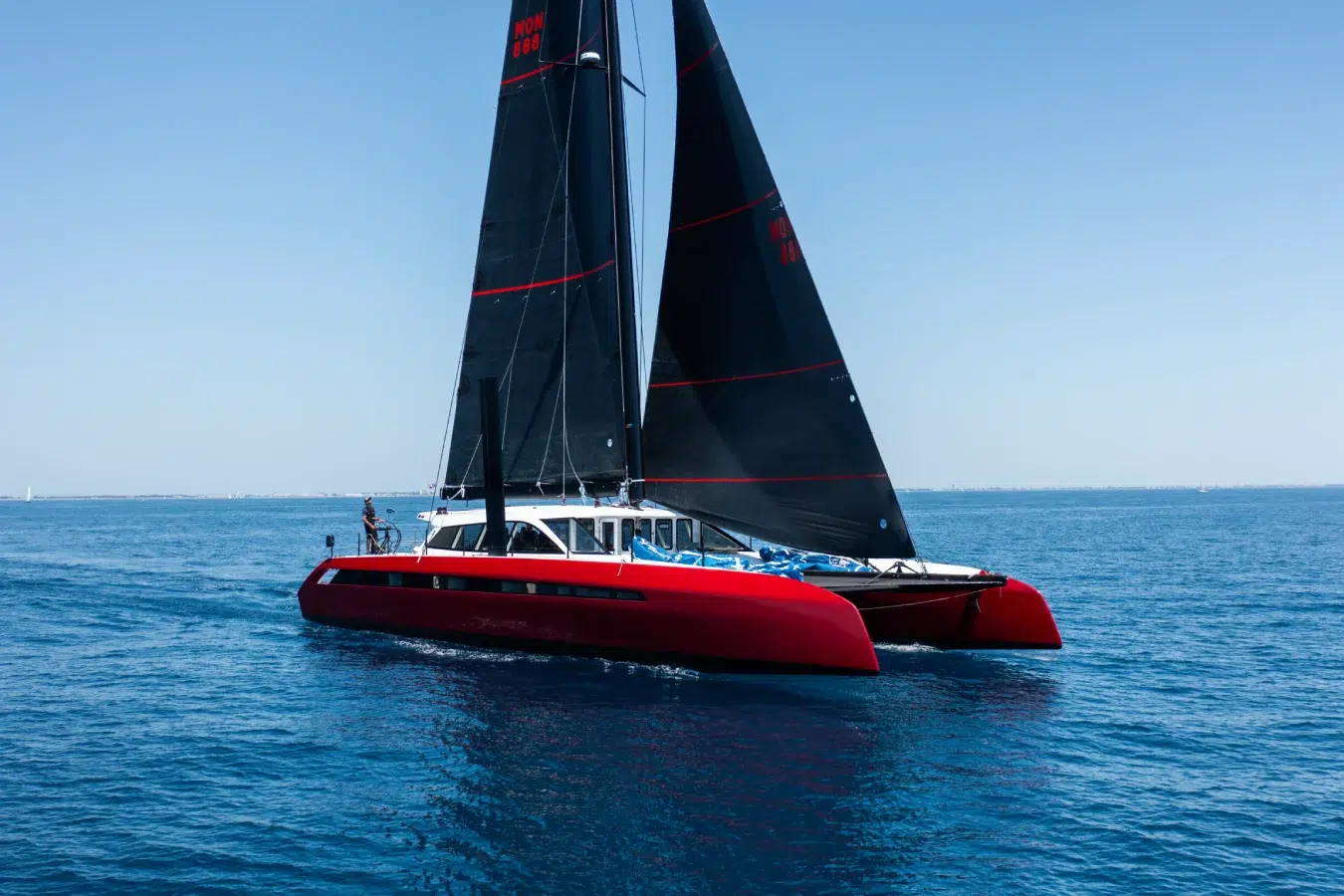
Twin hulls, low drag, shallow draft, exceptional stability: discover the defining characteristics of a catamaran hull and how design drives performance.
Twin hulls, low drag, shallow draft, exceptional stability: discover the defining characteristics of a catamaran hull and how design drives performance.
A catamaran hull is defined by one thing above all: there are two of them. Instead of a single hull carrying a weighted keel, a catamaran rides on twin slender hulls set wide apart and joined by a bridge deck. That basic architecture drives every other characteristic of a catamaran hull, and there are five that matter most. Twin hulls provide stability through their beam rather than through ballast, so the boat stays level instead of heeling. The hulls draw very little water, opening up shallow anchorages. Their narrow, low-drag shape reduces resistance and raises speed under sail. The wide platform delivers far more living space than a monohull of the same length. And because performance depends on staying light, the catamaran is more sensitive to weight than any single-hull boat. In this guide we walk through each of these traits and explain why they matter, both for the sailor and for the designer who shapes them.
Twin hulls: the defining feature
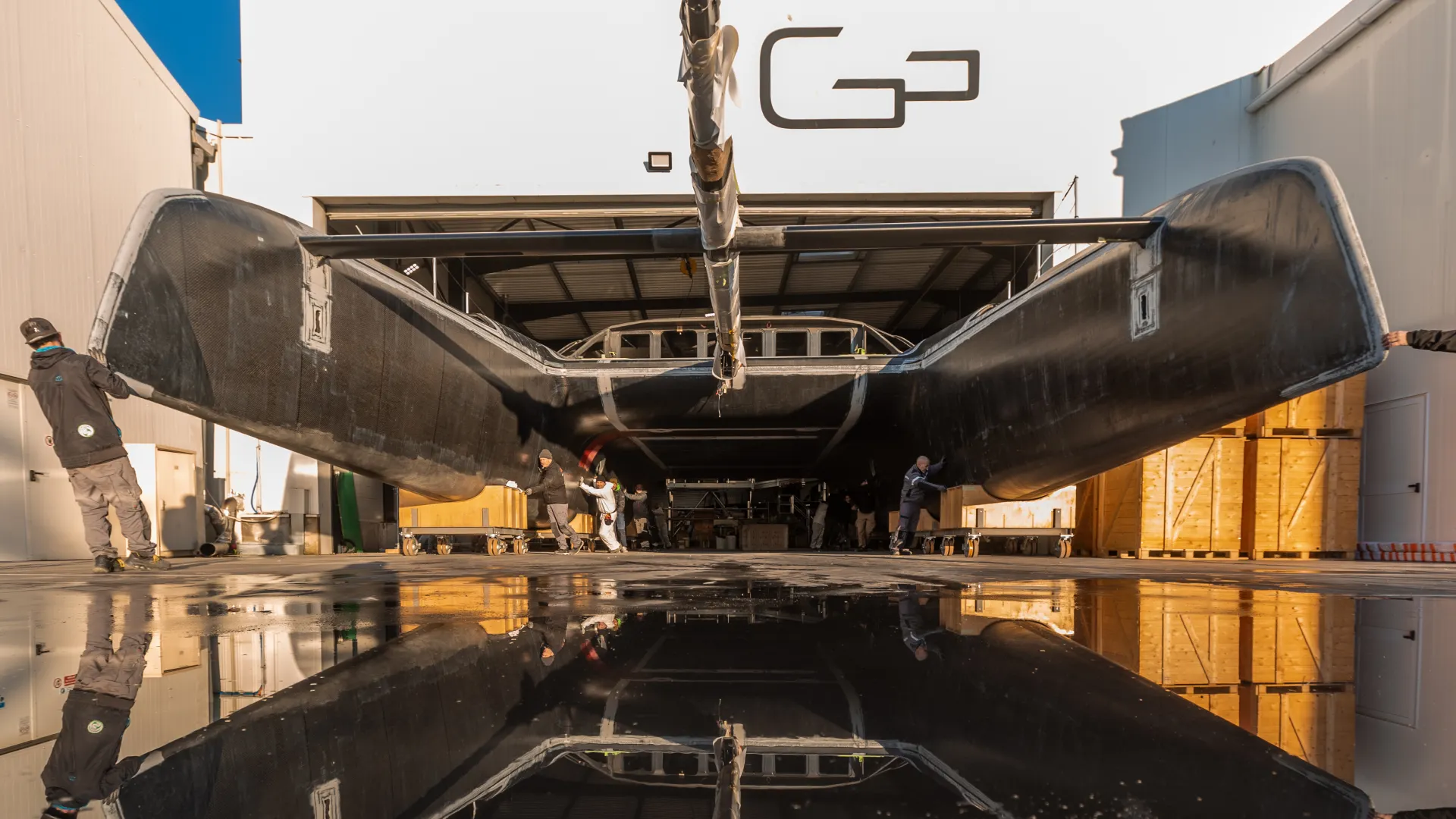
Where a monohull sailboat balances a single hull on a deep, weighted keel, a catamaran splits its buoyancy between two hulls. This is the core of twin hull design, and it is what places the catamaran in the wider family of multihull sailboats alongside the trimaran. Some people call these double hull boats, but the sailing term is multihull. Each hull is long, narrow and closed, and the two are held rigidly apart by cross structure.
The piece that ties everything together is the bridge deck, the platform spanning the gap between the hulls. It carries the saloon, the galley and much of the living space, and it turns two separate hulls into a single stable structure. The width between the hulls, the beam, is what gives a catamaran its stance on the water. A wide beam means a wide, stable base; it also means the loads trying to twist the two hulls apart are considerable, which is why the bridge deck and the beams that support it are among the most heavily engineered parts of the boat.
Stability: why catamarans don't heel
Stability is a boat's resistance to being tipped over, and catamarans achieve it in a fundamentally different way from monohulls. A monohull relies on ballast stability: a heavy keel hangs below the hull and acts as a pendulum, pulling the boat upright when the wind pushes it over. A catamaran relies on form stability: its two widely spaced hulls give it a broad footprint, so leaning the boat means lifting the entire weight of one hull out of the water. That takes enormous force, which is why a catamaran barely heels at all.
The practical consequences are what most sailors notice first. There is no constant angle to brace against. You cook, walk, sleep and navigate on a level surface. Crew fatigue drops sharply on long passages, and passengers who are not seasoned sailors stay comfortable and confident. For families and mixed-ability crews, this flat, secure motion is one of the strongest arguments for a catamaran.
There is a nuance worth understanding. Form stability is very high up to a point, but its curve is different from a monohull's. A ballasted monohull will lie over a long way and still right itself. A catamaran resists heeling powerfully across its normal sailing range, which is precisely why sail trim and reefing discipline matter: you manage the rig to stay well inside that range rather than relying on the boat leaning to spill wind. Sailed sensibly, that same form stability is what makes a catamaran feel so planted.
Shallow draft: where a catamaran can go
Draft is how deep the hull reaches below the waterline. Because a catamaran carries no deep ballast keel, its draft is remarkably shallow for its size. Many performance catamarans use daggerboards, retractable foils that drop down for upwind grip and lift up for shallow water, which gives the boat two very different draft figures.
Across the Gunboat range the numbers show how shallow a large performance catamaran can sit. The Gunboat 68 draws about 1.20 m with its daggerboards raised and roughly 3.0 m with them down. The Gunboat 72 sits at around 1.70 m boards up and about 3.8 m boards down. The larger Gunboat 80 draws roughly 1.30 m boards up, with the boards and T-foils reaching close to 5.8 m fully extended. Boards up, a 24-metre yacht floats in water barely deeper than a person is tall.
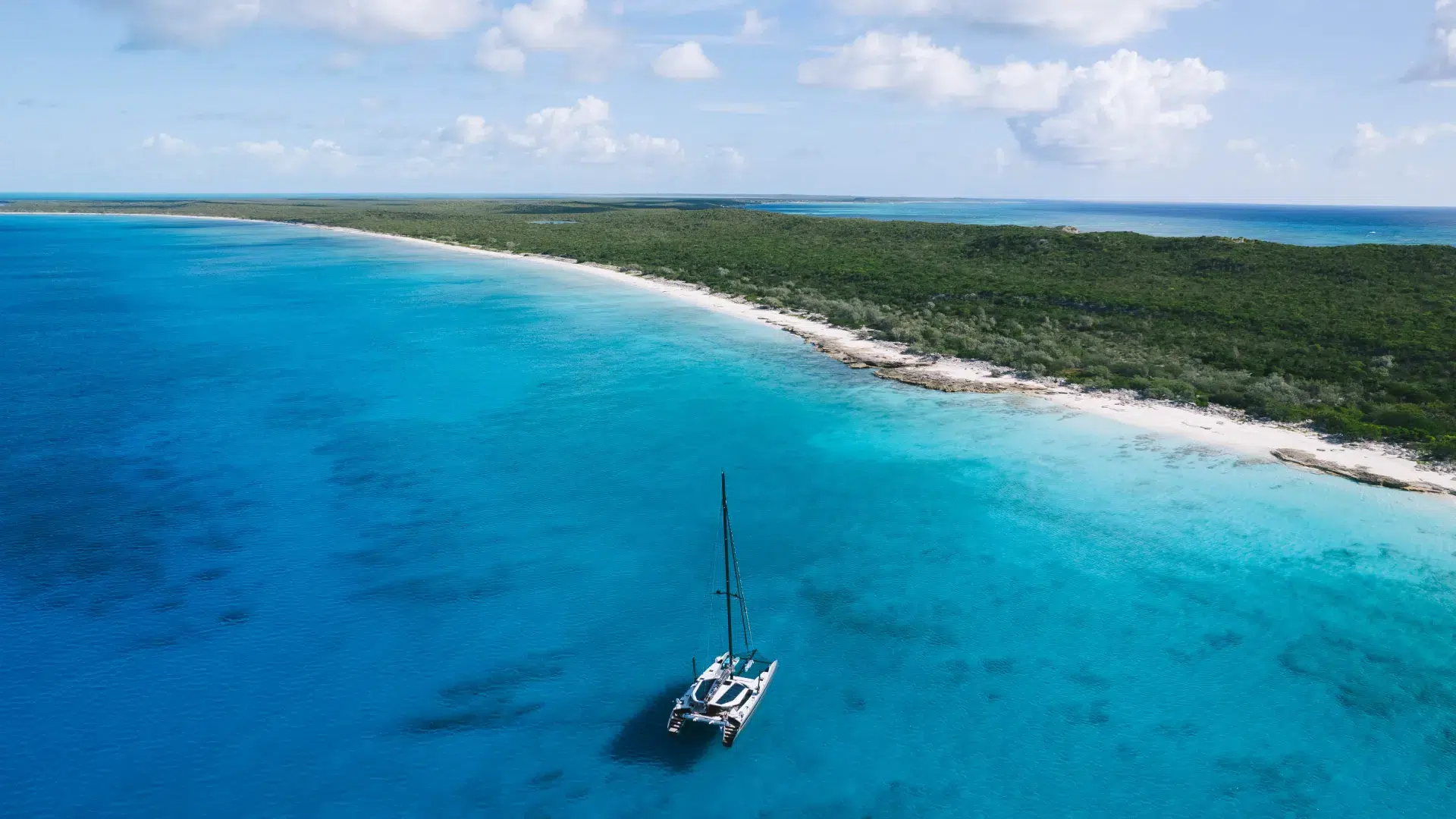
That shallow draft is a passport. It opens up lagoons, coastal anchorages and shoal waters that keel boats cannot reach, from the Bahamas to French Polynesia to the Adriatic coast. You anchor closer in, tuck into thinner water for shelter, and cruise areas where a deep-draft monohull would run aground. On a performance catamaran the routine is simple: boards down for sailing efficiency, boards up to slip into the anchorage.
Hydrodynamic resistance and speed under sail
The narrow shape of each hull is the key to catamaran speed. A slender hull has a small wetted surface, the area of hull in contact with the water, and low wetted surface means low hydrodynamic resistance. Less drag means more of the wind's energy turns into forward motion, so a well-designed catamaran sails fast in conditions where a heavier boat would still be lumbering.
Semi-displacement bow design
How the bow is shaped decides how the hull behaves at speed. A pure displacement hull always pushes water aside and is limited by its waterline length. A semi-displacement catamaran bow design lets the hull begin to lift and skim as speed builds, easing past that limit. Fine, wave-piercing bows cut through chop rather than slamming over it, keeping the ride smooth and the speed high as the breeze fills in.
Daggerboards: lift, leeway and performance
Daggerboards do more than reduce draft. Lowered, they generate hydrodynamic lift that resists the sideways push of the wind, cutting leeway and letting the boat point higher upwind. This is where performance catamaran design becomes a specialist discipline. Gunboat develops its hulls and appendages with the naval architecture firm VPLP using velocity prediction modelling to tune board and foil shapes. Combined with all-carbon construction, that engineering is what lets a Gunboat convert a slender, low-drag hull into genuine offshore speed without sacrificing seaworthiness.
Volume, space and living area
Two hulls plus a bridge deck add up to far more usable space than a single hull can offer. For a given length, a catamaran typically provides substantially more interior volume than an equivalent monohull, because the accommodation spreads across two hulls and the central platform rather than being crammed into one narrow canoe body.
The layout follows the structure. Cabins sit down in the hulls, naturally separated for privacy, often with a full-beam owner's cabin. The bridge deck becomes the social heart of the boat, a single-level saloon and galley with wraparound views. Outside, the wide beam gives generous deck and cockpit areas that flow straight off the saloon, so indoor and outdoor living merge. It is this combination of level motion and open volume that makes catamarans so well suited to both liveaboard cruising and entertaining.
Weight distribution and bridge deck clearance
A catamaran is more sensitive to weight than a monohull, and understanding why is central to understanding the hull. On a ballasted boat, adding gear mostly makes it sit a little deeper. On a catamaran, excess weight erodes the very things the twin-hull shape is built to deliver: the hulls sink, wetted surface grows, drag climbs, speed and light-air performance fall away, and the safety margin shrinks. Careful weight management, and keeping loads centred and low, is not optional on a fast catamaran; it is part of sailing one well.
This is also where construction shows its value. Because Gunboat builds in carbon composite, the structure itself is light, which leaves more of the total weight budget for payload before performance suffers. Bridge deck clearance, the air gap between the underside of the bridge deck and the water, is the other critical figure. Enough clearance lets waves pass beneath the platform instead of striking it; too little causes slamming in a seaway, which is loud, uncomfortable and hard on the structure. Gunboat's hulls carry roughly a metre of bridge deck clearance, generous for a cruiser-performance catamaran and a direct contributor to a smooth offshore ride.
Charter hulls vs performance hulls: two philosophies
Not all catamaran hulls are built for the same purpose, and this is the distinction most generic guides miss. There are broadly two design philosophies, and they produce very different boats from the same basic twin-hull concept.
Charter and volume-first hulls are wide, high-volume and comparatively heavy. They are optimised for stability at anchor, carrying capacity and maximum interior space. That makes them roomy and reassuring for holiday cruising, but the trade-offs are modest upwind ability, larger sailing angles and moderate speed.
Performance hulls take the opposite path. They are narrow, light and built in advanced composites, with daggerboards for upwind grip and hull shapes tuned for low drag. The priorities are speed, pointing ability and a lively, engaged feel under sail. This is the category Gunboat builds in: carbon construction, VPLP-designed hulls and daggerboard-equipped platforms conceived for fast offshore passages rather than static volume.
Understanding which philosophy a hull follows tells you far more about how a catamaran will actually sail than length or brand alone. If speed, seaworthiness and a rewarding helm matter to you, the hull's design intent is where to look first.