How fast do catamarans go?
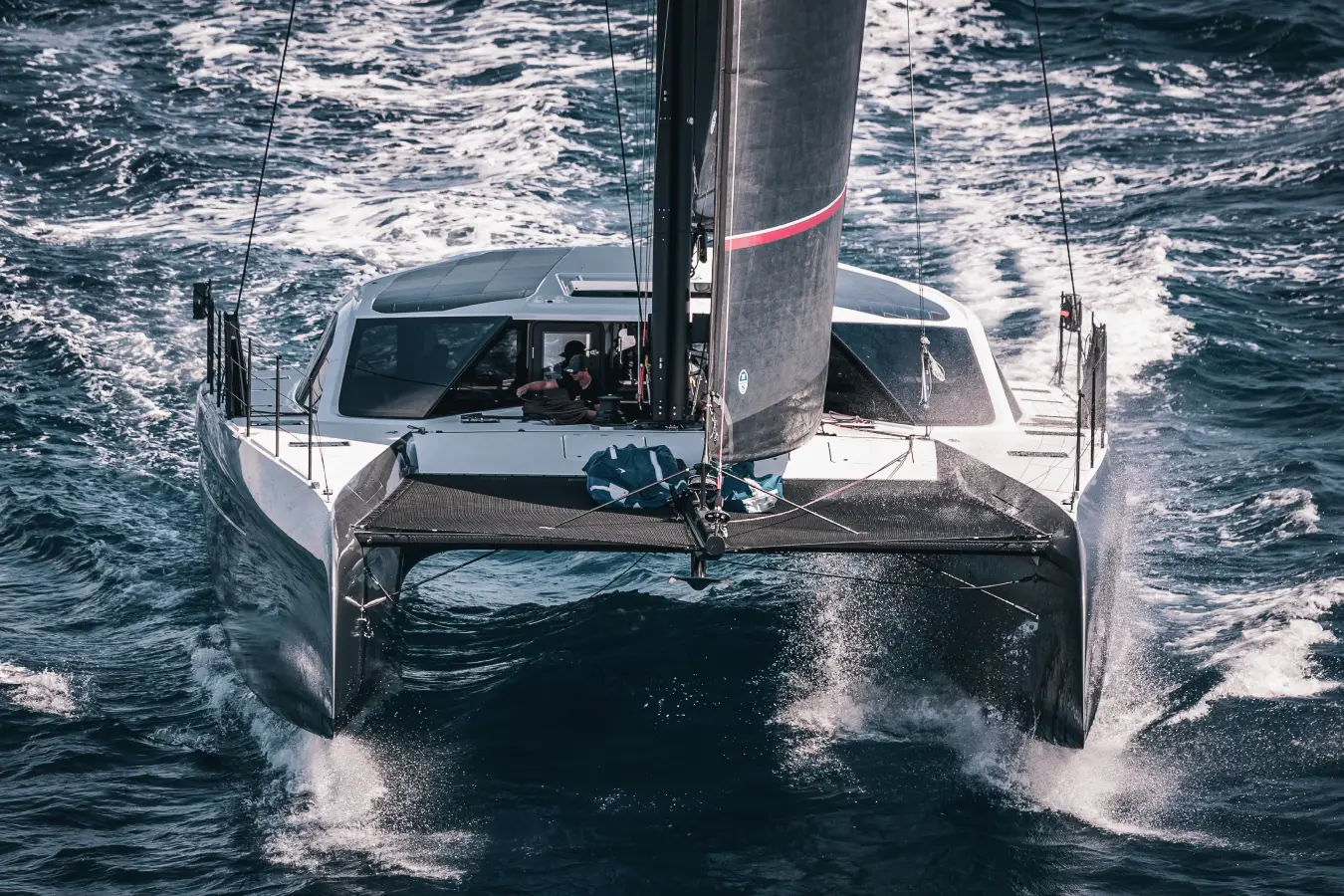
Most production cruising catamarans average 6 to 8 knots on an ocean passage and peak around 12 to 15 knots. Performance cruising catamarans average 10 to 14 knots and can touch 20 to 30 knots. Racing multihulls average above 20 knots offshore and peak past 40. The passage average, not the peak, is the number that matters.
How fast do catamarans go? The question sounds simple, and most answers online settle it with a single impressive number. The honest answer depends on four things: how much the boat weighs, how much sail it carries for that weight, what sits under the hulls, and whether you are quoting a moment or a whole passage. A 45-foot charter catamaran and a carbon performance cruiser share two hulls and very little else.
This guide gives you real catamaran speed figures in knots, by category. It then explains the physics behind those numbers, and finally looks at what speed actually changes when you are a thousand miles from land.
Average catamaran speeds, by type
The ranges below describe boats sailed competently on real ocean passages, loaded for cruising where that applies. They are deliberately less spectacular than many figures you will find online, because they describe averages over days, not the best reading ever seen on the instruments.
Production cruising catamarans (40-50 ft)
A production cruising catamaran typically averages 6 to 8 knots on an ocean passage and tops out around 12 to 15 knots. These boats are heavy for their length, sit on fixed keels and offer generous interior volume. They are designed for comfort and payload first, and their speed reflects that trade-off.
Production cruising catamarans are the reference point for most buyers. On the Atlantic Rally for Cruisers, roughly 2,700 nautical miles from the Canary Islands to Saint Lucia, the fleet typically needs 17 days to three weeks, which works out to about 5.5 to 6.5 knots.
Performance cruising catamarans (50-80 ft)
A performance cruising catamaran typically averages 10 to 14 knots on passage and can reach 20 to 30 knots at the top end. Carbon or advanced composite construction keeps weight down, while daggerboards and tall rigs add power and upwind efficiency. In moderate breeze, these boats sail at or above the speed of the wind.
Performance cruising catamarans sit in a different bracket. Gunboat designs its range around a cruising speed of 12 to 15 knots sustained over long distances, and race results confirm that order of magnitude (see below).
Racing multihulls
Offshore racing catamarans and trimarans average 20 to 30 knots or more on passage, with peaks above 40 knots. They carry minimal accommodation, rely on lifting foils and are sailed by professional crews. They are built to break records, not to be lived aboard.
At the top of the scale, ocean racing multihulls, mostly giant trimarans, play another game entirely. When IDEC Sport set the round-the-world record in 2017, the crew averaged 26.85 knots over the distance actually sailed, with peaks between 38 and 44 knots. That record was lowered again in January 2026 by Sodebo Ultim 3, in 40 days and 10 hours.
Passage average vs top speed: why the difference matters
A top speed is an instant. A passage average is a performance. The first tells you what a boat did while surfing down one wave, with the right crew, the right sail up and often very little aboard. The second tells you what it did through the night watches with a reef in, across the light-air holes, on the upwind legs and while waiting out a squall.
Most speed figures published online are peaks, because peaks come straight from a GPS maximum and make better headlines. The problem for a buyer is that a peak says almost nothing about the trips you will actually make. On a typical production catamaran, the passage average is often around half of the recorded top speed.
A concrete example: in the 2025 Transpac, the Gunboat 68 Convexity covered the 2,225-mile course from Los Angeles to Honolulu in an elapsed time of 7 days, 2 hours and 31 minutes. That works out to roughly 13 knots over the rhumb line, and the average includes a windless high-pressure zone that stalled the boat mid-race. The crew reported consistently sailing above 20 knots while surfing Pacific swells. Twenty knots was the sensation. Thirteen knots was the performance. Keep in mind that Convexity is a race-optimized 68 with an extended rig and reworked appendages.
Why hull speed doesn't apply to multihulls
On a displacement monohull, speed hits a soft ceiling known as hull speed. As the boat moves, it creates a bow wave and a stern wave. The faster it goes, the longer that wave system becomes, until the wavelength matches the waterline length. At that point the hull sits in the trough of its own wave and would have to climb uphill to go faster.
The classic rule of thumb puts hull speed at about 1.34 times the square root of the waterline length in feet. A 36-foot waterline gives roughly 8 knots, a 49-foot waterline roughly 9.4 knots. Pushing a heavy ballasted hull beyond that takes a disproportionate amount of power, which is why cruising monohulls rarely do it outside of surfing.
A catamaran hull works differently. Each hull is long and very narrow, with a length-to-beam ratio that can exceed 10 to 1 on performance designs, against roughly 3 or 4 to 1 for a typical monohull. A slender, light hull generates a much smaller wave and slices through the water instead of pushing it aside. There is no wall to climb, only drag that increases progressively. Stability comes from the beam between the hulls rather than from a lead keel, so there is no ballast to carry either. For more on hull geometry, see what are the characteristics of a catamaran hull.
The caveat matters: a heavy catamaran with full-bodied hulls behaves much more like a displacement boat. Two hulls alone do not make a boat fast.
What actually makes a catamaran fast
Weight and displacement
Weight is the first factor, and the one most often underestimated. Every kilo has to be carried, accelerated and lifted over waves. Carbon and Nomex sandwich construction saves tonnes compared with conventional glass, but cruising equipment adds them back: water, fuel, tender, generator, watermaker, provisions and personal gear. Gunboat's own specifications for the 72 illustrate the spread: 23.5 tonnes as specified, up to 31 tonnes at maximum load. This is why weight estimates are a contractual commitment at Gunboat.
Sail area to displacement ratio
The sail area to displacement ratio (SA/D) divides sail area by displacement raised to the power two-thirds. It measures how much power the rig provides per unit of weight, and it predicts light-air performance far better than length. Production cruising catamarans generally sit in the high teens to low twenties; performance catamarans run from the high twenties into the thirties.
Appendages: daggerboards vs fixed keels
Fixed low-aspect keels are simple and protect the hulls when grounding, but they generate less lift and cannot be retracted. Daggerboards are deeper and more efficient upwind, and can be raised downwind to reduce wetted surface. On the Gunboat 68, owners choose between three board configurations, from short symmetrical boards for cruising to long asymmetrical boards for racing.
Waterline length and hull shape
A longer waterline raises the speed potential of any hull, and slender, fine-entry hulls reduce drag and pitching. Bridgedeck clearance matters offshore too: a high bridgedeck limits wave slamming, which otherwise forces the crew to slow down long before the boat's limit.
Apparent wind and why fast boats get faster
As boat speed rises, the wind felt on board, the apparent wind, moves forward and strengthens. A fast boat effectively creates part of its own wind, which lets it keep sailing at efficient angles even when heading downwind. That is how a well-designed performance catamaran sails faster than the true wind: VPLP's calculations for the Gunboat 80 predict boat speed above wind speed as soon as the breeze exceeds 6 knots.
How to read a polar diagram
A polar diagram plots the predicted boat speed, shown as the distance from the center, against the true wind angle, shown around a half circle, with one curve for each true wind speed.
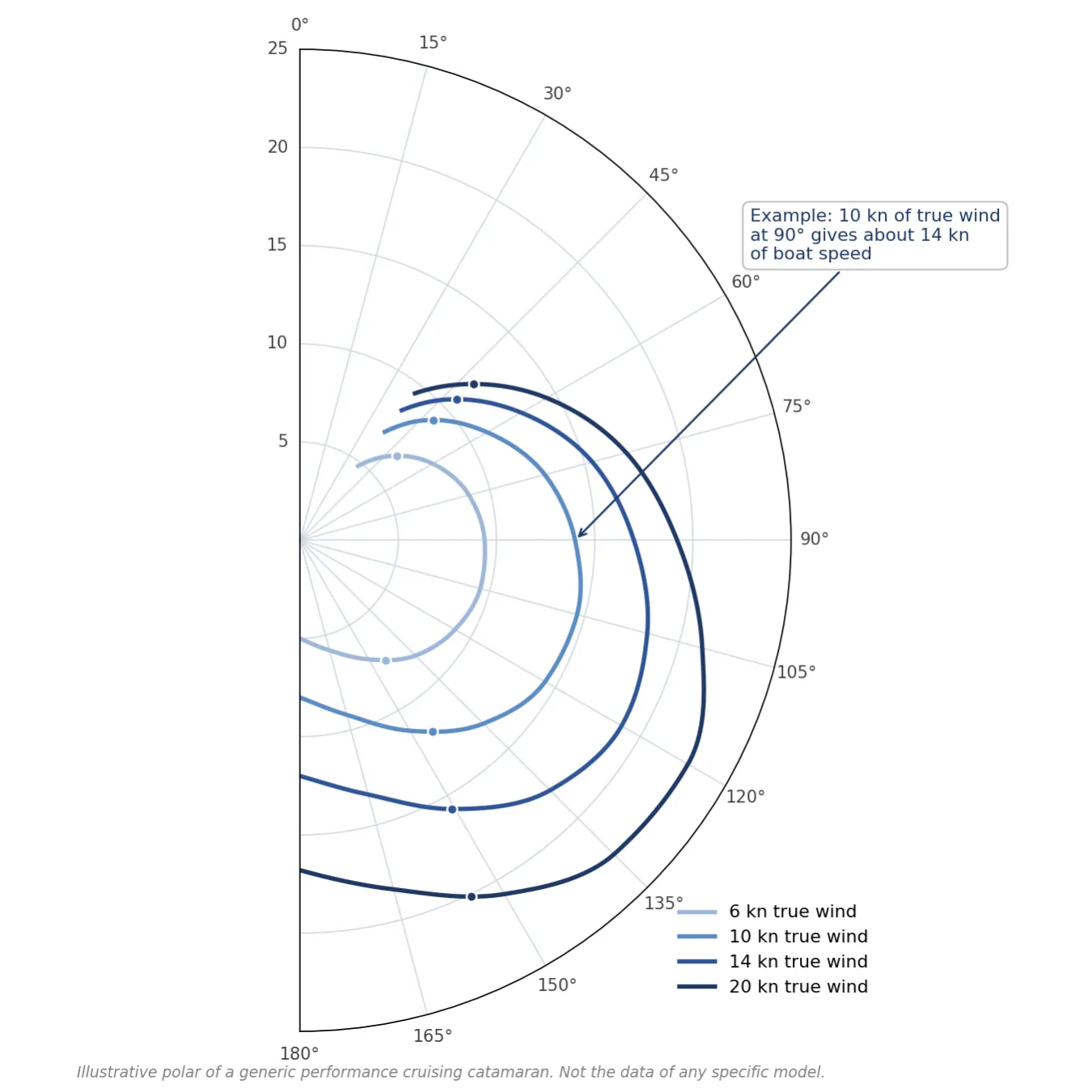
To read it, pick the curve for the wind strength you care about, follow it to the angle you plan to sail, and read the boat speed. Three things jump out quickly: the angle where the boat is fastest (usually a beam or broad reach), the best angles for making progress upwind and downwind, and how the inner curves behave, which tells you how the boat handles light air. Comparing the boat speed to the wind speed on each curve also shows you immediately where the boat sails faster than the wind.
One caveat: most polars are predictions calculated by the designer for a given load. A polar built from logged sailing data is far more valuable. Always ask which one you are looking at.
What speed changes on a long passage
Offshore, speed is first and foremost a safety tool. Weather forecasts are generally reliable over three to five days. A boat averaging 7 knots covers about 170 miles a day, or roughly 840 miles in a five-day window. At 13 knots, the same window gives roughly 1,560 miles, which is most of an ocean crossing inside a single reliable forecast.
That changes how you sail. A fast boat can wait in port for the right window and then run with it. It can move around a developing low instead of sitting through it, or reach the favorable side of a system before it closes. And every day cut from a crossing is one less day of exposure to gear failure, crew fatigue and weather you did not choose.
This is the argument most speed discussions miss. The value of a fast catamaran is not the thrill of a 25-knot surf. It is arriving in the Caribbean in eight or nine days instead of sixteen, with a crew that is still rested.
Our advice: Judge a boat on its passage average, loaded for cruising, not on a peak logged while racing light. It is the only number that describes the trips you will actually make.
Performance across the Gunboat range
Across the range, the design target is the same: a cruising speed of 12 to 15 knots sustained over long distances. The Gunboat 68, designed with VPLP in full carbon, was announced at around 16 tonnes. Its race-optimized version, Convexity, gained about 2 knots downwind and half a knot upwind over the standard regatta setup, before averaging roughly 13 knots across the Transpac.
The Gunboat 72 adds a flybridge and considerably more volume, at 23.5 tonnes as specified, while still sailing at wind speed from 8-10 knots true, thanks to its symmetrical daggerboards and the slender hull lines inherited from the 68.
The Gunboat 80 weighs around 28 tonnes. According to VPLP, she accelerates quickly to 14-15 knots in moderate winds and can approach 30 knots in a fresh breeze on flat water.
So, how fast do catamarans go? Anywhere from 6 knots to more than 40, depending on what you are measuring and which boat you are talking about. But the useful question is not "how fast". It is "at what average, in what conditions, and with what comfort". Ask for the passage average, loaded, with its conditions attached, and read the polar. Those two documents will tell you more about a catamaran than any top speed ever will.