What maintenance does a carbon catamaran need?
Short answer: A carbon catamaran needs the same annual routine as any well-kept yacht: hull, appendages, deck hardware and systems. Two items are specific to carbon: regular checks of the rig and its terminations, and inspection of any area that has taken an impact. Carbon does not corrode. It asks for attention, not extraordinary precautions.
Carbon fiber still carries a reputation borrowed from racing. Fragile, temperamental, expensive to keep. For a buyer weighing a carbon catamaran against a glass composite boat, that reputation turns into a simple question: what will owning it actually involve, year after year?
The honest answer is less dramatic than the myth. Most of carbon catamaran maintenance is ordinary yacht maintenance. A smaller part is genuinely different, and it is worth understanding before you buy rather than after.
This guide walks through both: what stays the same, what changes, how a carbon rig is looked after, how impact and UV are managed, who can repair a carbon laminate, and how to track the structure over the life of the boat. It is written from the shipyard side, by people who build and refit these boats.
How carbon differs from glass composite in daily ownership
Both materials are composites: fibers held in a resin matrix, usually epoxy on a performance boat, often laid over a foam core. The difference lies in how the laminate behaves over time and under load.
Carbon does not corrode. It does not rust, pit or oxidize the way metal structures do, and it has excellent fatigue resistance. A well-built carbon laminate tolerates millions of load cycles without the gradual softening that can affect a more flexible structure.
Stiffness is the second difference. A stiff hull and bridgedeck move less in a seaway, which means less working at joints, bulkheads and hardware mounting points. Fewer squeaks, fewer stress cracks around fittings, and less long-term fatigue in the secondary structure.
The trade-off is how carbon signals a problem. Glass composite tends to flex and show distress before it fails. Carbon is stiffer and gives fewer visible warnings: a laminate can look intact on the surface while a core debond or delamination sits underneath. That is the single most important idea in this guide. On a carbon boat, maintenance relies on inspection, not passive observation. You check deliberately, at set intervals and after specific events, rather than waiting for something to look wrong. None of this makes carbon fragile. It makes it a material that rewards a methodical owner.
The annual routine
Most of the yearly work on a carbon catamaran is the same as on any well-maintained yacht. Saying so plainly is more useful than pretending otherwise.
Haul-out and antifouling
A yearly haul-out covers hull cleaning, a check of the underwater finish and fresh antifouling. On a carbon hull, the antifouling sits on a barrier coat and primer system that seals the laminate. The point to watch is that system's integrity: any chip or abrasion down to the laminate is noted and repaired before new paint goes on. Through-hulls and underwater metal fittings are checked for their isolation from the carbon (see galvanic considerations below).
Appendages: daggerboards, rudders and bearings
Daggerboards and rudders are where a performance catamaran meets the unexpected: debris, groundings, hard landings. Each haul-out includes a visual and tap check of the boards and rudder blades, especially leading edges and tips, plus a check of bearings and their play. Worn bearings are a normal wear item, not a carbon issue. For how daggerboards affect performance, see our article about the characteristics of a catamaran hull.
Deck hardware and running rigging
Winches, clutches, blocks, tracks and running rigging get the usual service: cleaning, lubrication, replacement of worn lines and chafed covers. The carbon-specific point is the base of each fitting: look for paint cracking or sealant failure around load-bearing hardware, which can mean water reaching the core.
Systems and energy
Engines, electrical systems, batteries, watermakers and electronics follow their manufacturers' service schedules, exactly as on any yacht. The hull material changes nothing here.
Looking after a carbon rig
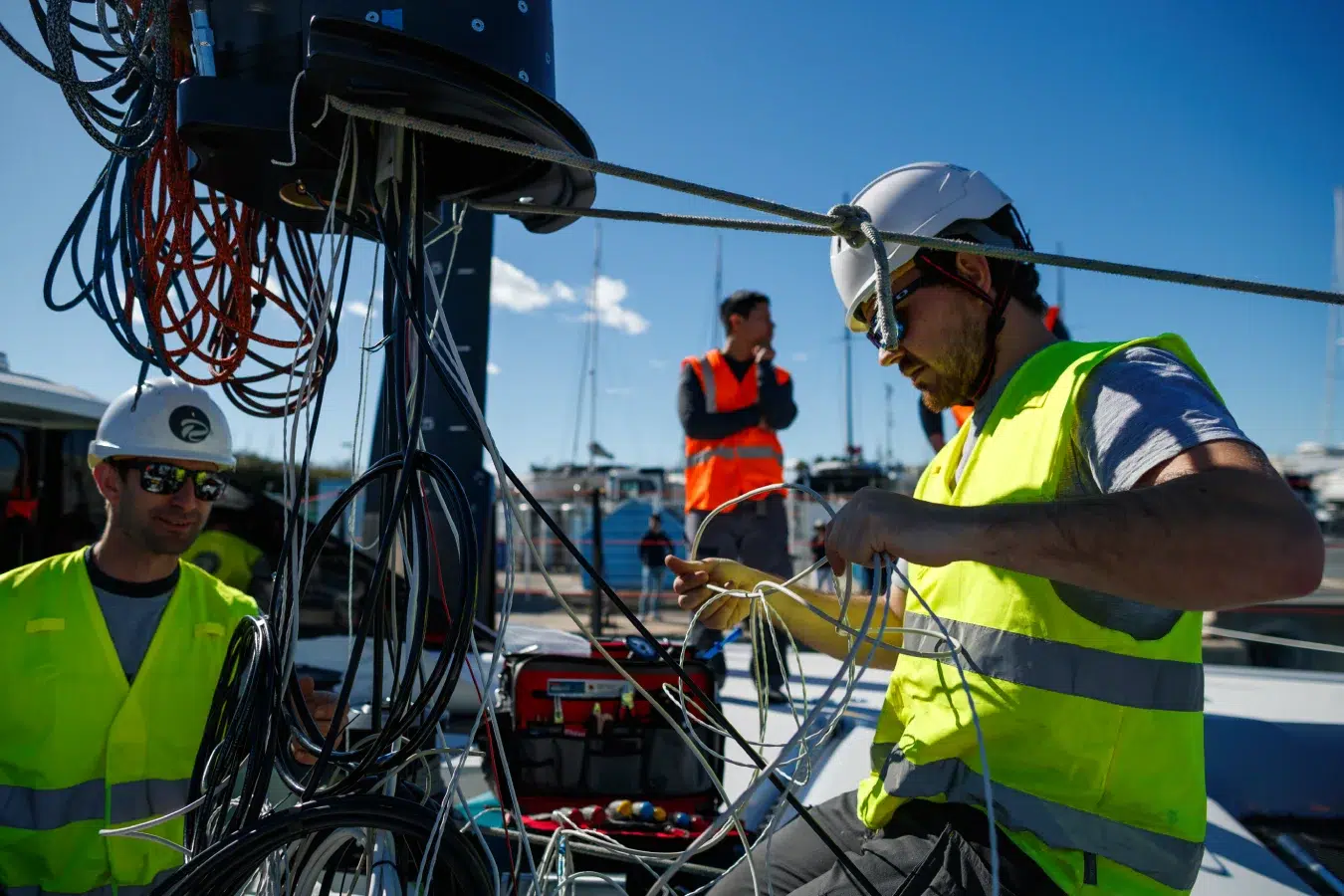
The rig is where carbon catamaran maintenance genuinely differs. A carbon mast is light and stiff, and it carries very high loads into a small number of attachment points. Those points, and the standing rigging that connects to them, are what you inspect.
What gets checked
A rig check on a carbon mast concentrates on the places where load enters the tube: the mast step and the partners at deck level ; spreader roots and spreader tips ; shroud and forestay attachment points, tangs and their fastenings ; halyard exits, sheaves and the masthead ; the gooseneck and any boom or vang fittings ; the surface finish along the whole length, looking for paint cracks, crazing or chafe.
A crack in the paint is not automatically a crack in the laminate. It is a reason to look closer, never a reason to ignore.
Standing rigging and terminations
Whether the boat carries composite (fiber) rigging or rod, the terminations deserve the most attention: the fittings at each end, where the cable or rod meets the hardware. Look for chafe on covers, deformation, corrosion on metal parts and any movement in the fitting. Replacement intervals for standing rigging depend on the material, the manufacturer's guidance and the miles sailed. Treat any single figure you read online with caution, and follow the rig maker's schedule.
How often
A visual rig check belongs in every annual routine, ideally with someone going aloft. A deeper inspection by a qualified rigger follows the rig maker's recommendations.
After a hard passage
Some events call for a check before the next sail, whatever the calendar says: a strong blow, an ocean crossing, an accidental gybe under load, a broach, a collision with a dock or another mast. If something looks or sounds different, or a fitting has moved, a detailed inspection is due, and non-destructive testing such as ultrasound may be used to see inside the laminate.
Impact, UV and finish
Impact damage
Carbon does not dent. A knock that would leave a mark on aluminum may leave nothing visible on a painted carbon surface, while the laminate or the core bond beneath has taken damage. That is why any significant impact (a floating object, a hard docking, a dropped heavy item on deck) earns an inspection even when nothing shows. The first tool is a simple tap test: a sound laminate rings, a debonded area sounds dull. Doubtful areas then go to ultrasound or thermography. The concern is delamination and, over time, moisture reaching the core through a damaged skin.
UV and paint
Carbon fibers themselves are not damaged by sunlight. The epoxy resin around them is: prolonged UV exposure breaks it down at the surface. That is the real job of the paint system on a carbon boat, which is usually painted rather than gelcoated. Keeping the paint intact, touching up chips and protecting exposed carbon parts is the UV strategy. A clear-coated visible carbon finish needs a UV-resistant topcoat that is maintained like any varnish.
Galvanic considerations
This is rarely explained to owners, and it matters. Carbon is electrically conductive and sits at the noble end of the galvanic scale. In the presence of seawater, a metal fitting in direct contact with carbon, especially aluminum, becomes the sacrificial side and corrodes. The answer is galvanic isolation: an insulating layer, isolating sleeves and washers, and careful bedding between carbon and metal. Maintenance means checking that this isolation is still intact around fittings, chainplates and through-hulls, and restoring it whenever hardware is removed and refitted.
Repair: who can do it and what it involves
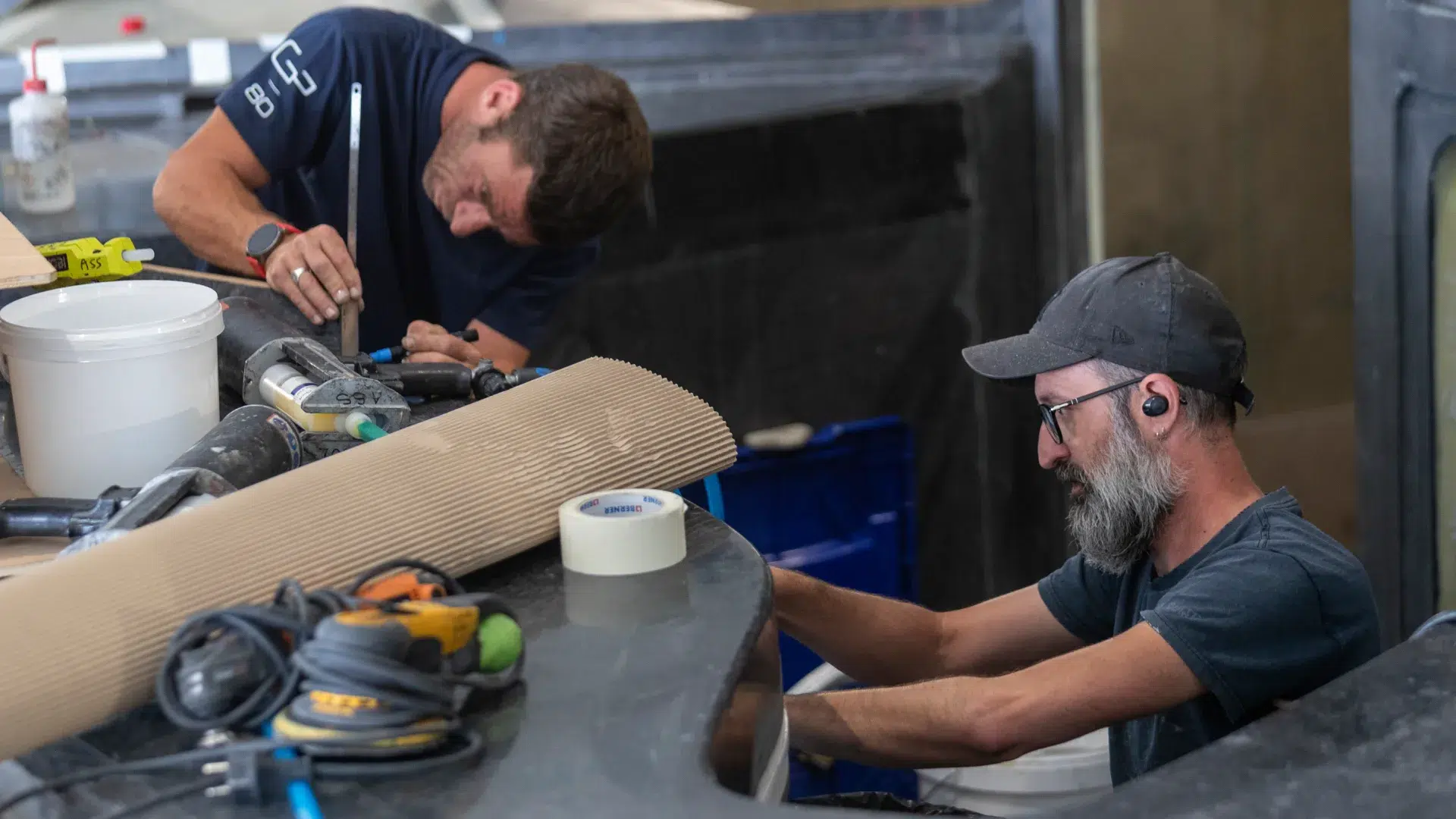
Carbon is repairable. A damaged area is ground back in a shallow taper, any wet or debonded core is removed and replaced, and new plies are laid up to rebuild the original laminate. The repair is then consolidated under vacuum and cured.
The word that matters is 'original'. A good composite repair restores the laminate the engineers designed: the same number of plies, the same fiber orientations, compatible resin and a cure that matches the original process. A repair that simply fills the hole with extra material may look fine and still change how loads travel through the structure. That is why the quality of a repair matters more than the fact that one exists.
This is also where the original shipyard brings something no one else can: the laminate schedule, the structural drawings and the build records of that specific hull. Knowing exactly what was built allows a repair to replicate it rather than approximate it.
Small cosmetic damage and minor repairs on non-structural parts can often be handled locally by a competent composite technician working to the builder's specification. A return to the shipyard, or at least close involvement of the shipyard, makes sense when the damage is structural: hull or bridgedeck laminate, bulkhead bonds, chainplate areas, mast step, daggerboard trunks, or anything involving the rig. The same applies to a major refit. Whoever does the work, ask for the repair to be documented and added to the boat's history.
Structural monitoring over the life of the boat
Over the years, structural inspection on a carbon catamaran follows the areas that carry the highest loads: chainplates and their bonds, the mast step and the structure below it, daggerboard trunks and rudder bearings, bulkhead bonds and the bridgedeck. Each is checked against its previous state. What you want to know is not only whether it is sound today, but whether anything has changed.
That comparison is only possible with a continuous maintenance log. A good log records each haul-out, each rig check, each impact and how it was assessed, each repair with its documentation, and the dates and scope of every inspection. Photos taken at the same points year after year are especially valuable.
A complete service history is also what a future buyer and their surveyor will ask for. A carbon boat with a documented life is far easier to assess than one with gaps. If you are on the other side of that conversation, our guide to buying a used performance catamaran covers what to look for.
How Gunboat supports its owners
Gunboat catamarans are designed with VPLP and built in carbon composite at our shipyard in La Grande Motte, France. The same shipyard follows the boats after delivery.
Because each hull is built here, the shipyard holds its construction records: laminate schedules, structural drawings and the specifics of each boat. That knowledge supports owners when a question comes up, whether it is an inspection result to interpret, a repair to specify or a modification to plan.
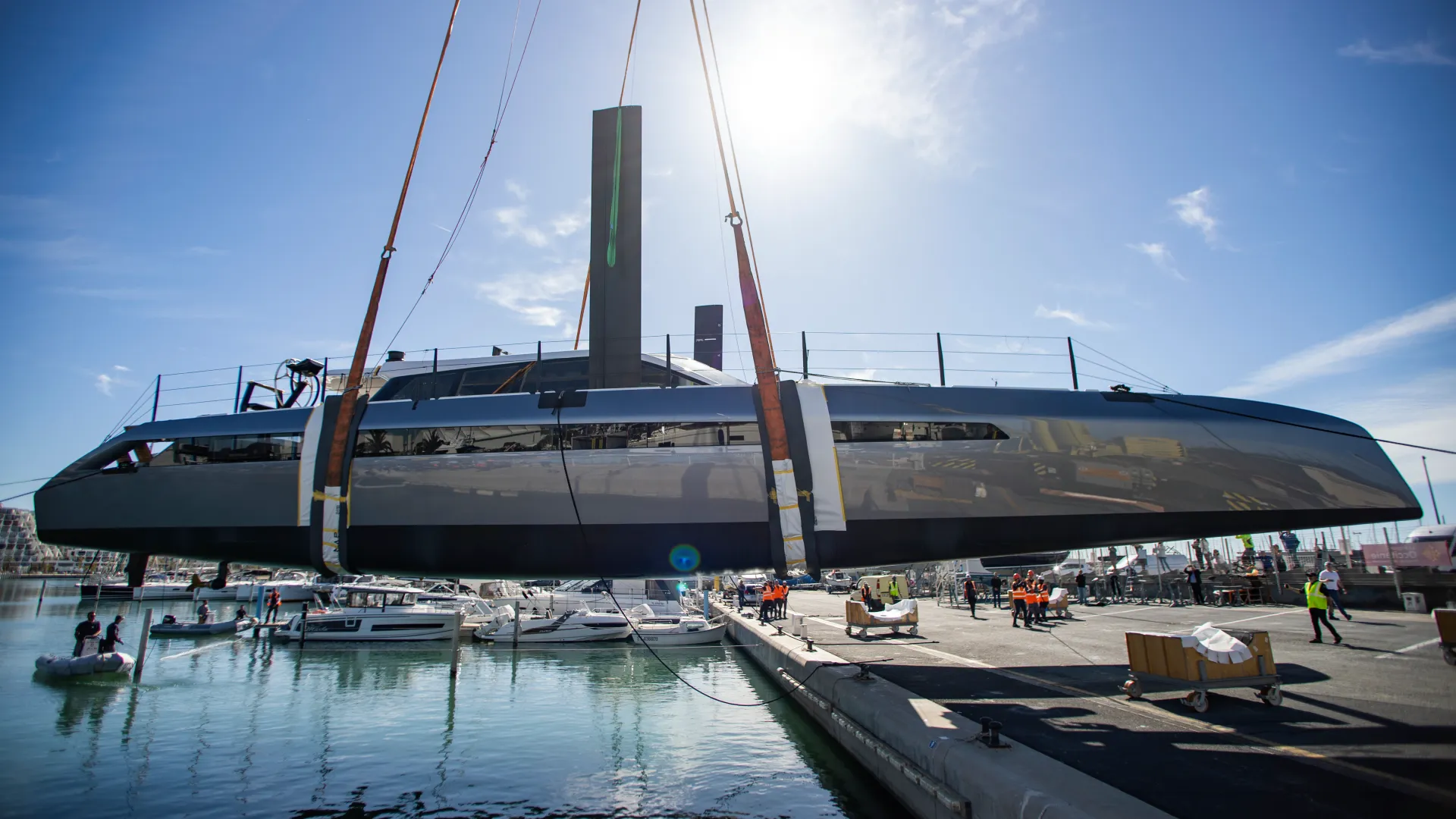
La Grande Motte also hosts refit capacity for haul-outs, structural work and rig projects, carried out by the teams who know how these boats are built. Owners sailing far from France can work with local professionals, with the shipyard providing technical input. See how each series is built on the Gunboat 68, Gunboat 72 and Gunboat 80 pages.
A carbon catamaran is not a fragile boat that needs extraordinary care. It needs a methodical owner: the usual annual routine, a rig looked after with real attention, inspection after impacts, intact paint and galvanic isolation, and a log that records it all. Carbon asks for rigor rather than precautions, and in return it gives a structure that stays stiff, does not corrode and keeps its qualities for a long time. Choose the people who repair it carefully, keep the records, and the material does the rest.