Sailing a catamaran: A step-by-step guide for new sailors
Sailing a catamaran is different from sailing a monohull, and understanding those differences is the key to confident, capable catamaran sailing. Whether you are stepping aboard for the first time or transitioning from a keelboat, the fundamentals are quicker to grasp than most people expect. This guide walks you through the essentials, from preparation and getting underway to the techniques and safety habits that define time on a multihull, and finishes with what changes when the boat beneath you is a genuine performance catamaran.
What makes sailing a catamaran different from a Monohull?
If you are coming from a monohull, this is almost certainly your first question. Three differences shape everything else about how a catamaran behaves and how it feels to sail.
Stability: no heel, no tilting
A catamaran sails flat. With two hulls set wide apart, it resists heeling in a way a single-hulled boat simply cannot. The practical consequences run through the whole experience: you can cook, move around and rest without bracing against a tilted deck, motion is slower and wider rather than sharp, and crew fatigue drops noticeably on a long passage. Flat sailing also changes how you read the boat, since you rely more on speed, sound and instruments than on the angle of heel a monohull sailor learns to feel.
Two helm stations, two engines: twin redundancy
Most cruising catamarans carry two engines, one in each hull, and often two steering positions. The redundancy matters offshore, but the bigger day-to-day change is manoeuvring. With engines set far apart, you can turn the boat almost within its own length by driving one ahead and one astern. Once it clicks, close-quarters handling in a marina becomes more precise than on many monohulls, not less.
The role of the bridge deck and life onboard
The bridge deck, the structure spanning the two hulls, carries the saloon and living space on a single, level plane connected to the cockpit. Life onboard is genuinely different: more space, natural light, and an indoor-outdoor flow that a monohull cannot replicate. It is one of the main reasons sailors make the switch. For the naval-architecture side of how these hulls are shaped and why, see our companion piece: What are the characteristics of a catamaran hull.
Before you sail: Essential preparation
Good sailing starts at the dock. A short, consistent routine before you leave removes most of the surprises a new catamaran sailor runs into.
Boat inspection checklist
Run the same quick checks every time, in the same order, until they become automatic:
• Rig and standing rigging: visual check for chafe, loose fittings or damaged lines
• Sails and running rigging: halyards and sheets free, no knots, furlers turning cleanly
• Engines and fuel: oil, coolant, fuel level, and a look in each engine bay
• Steering and helm: both stations responding, autopilot powered
• Safety gear: lifejackets, harnesses, jacklines, VHF, flares in date, bilge pumps working
• Deck: nothing loose, hatches secured, boarding steps and lines stowed
Reading weather and choosing your window
On a catamaran, wind speed and sea state drive your decisions more directly than on a monohull, because the boat carries sail efficiently and accelerates quickly. Check a reliable forecast for wind strength, gusts, direction and sea state before you leave, and build the habit of choosing a sensible weather window rather than sailing to a fixed schedule. Reducing sail early, before conditions build, is a recurring theme on a multihull.
Step-by-step: Getting underway
Here is the core sequence, from a quiet berth to sailing on a set course. Each step pairs the action with the mistake new sailors most often make.
Step 1 - Engine start and pre-departure checks
Start both engines, confirm cooling water is flowing from each exhaust, and let them warm briefly. Check that both helms respond, brief the crew on their roles, and confirm fenders and lines are ready to handle.
Step 2 - Casting off and leaving the marina
Release lines in a planned order, then use differential thrust - one engine ahead, one astern - to pivot the bow toward open water. Move slowly and let the wide beam work for you rather than fighting it with the wheel.
Step 3 - Raising the mainsail
Turn the boat head to wind, ease the mainsheet and traveller, then hoist the main on its halyard. Keep the boat pointing into the wind until the sail is fully up and the halyard tensioned.
Step 4 - Setting course and trimming sails
Bear away onto your course, unfurl the headsail, then trim both sails to the wind angle. Settle the boat, engage the autopilot if you wish, and shut down the engines once you are sailing cleanly.
Catamaran sailing techniques
The four points of sail on a catamaran
The four points of sail - close-hauled, beam reach, broad reach and running - work the same in principle on a catamaran, but the feel differs. A catamaran is happiest reaching, where its speed and stability shine. Close-hauled, it points slightly less high than a fine monohull unless it is fitted with daggerboards, which we come back to below.
Tacking: slower than a monohull, plan ahead
Tacking a catamaran is slower and wider than tacking a monohull. The boat carries less momentum through the eye of the wind, so you commit earlier, keep some speed on, and let the headsail help pull the bows round. Anticipation is everything: plan the tack before you need it rather than snapping the helm over.
Jibing: controlled and methodical
Jibing is methodical rather than dramatic. There is no risk of a heeling broach as on a monohull, but the mainsheet loads still need managing so the boom crosses under control. Sheet in before the stern passes through the wind, let the sail cross, then ease out on the new side.
Sail trim: finding the sweet spot
Because a catamaran does not signal overpressure by heeling, you trim to other cues: telltales streaming evenly, boat speed, and the note of the rig. Look for the sweet spot where the sails are full but not stalled, and be ready to ease or reef as the wind builds rather than waiting for the boat to tell you the hard way.
Common mistakes beginners make
Most early errors on a catamaran come from monohull instincts that no longer apply. A simple listing of the frequent ones:
• Over-using the engines. Convenient, but you never learn to sail the boat.
• Under-estimating the tack. Snapping the helm over stalls the boat head to wind.
• Skipping the weather check. A fast boat reaches building conditions sooner than you expect.
• Overloading the boat. Extra weight blunts performance and eats into bridge deck clearance.
• Ignoring bridge deck clearance. An overloaded or poorly trimmed cat slaps in a seaway.
• Poor light-air trim. Catamarans reward patient trimming when the breeze is soft.
• Underestimating leeway without daggerboards. Boats without boards make more leeway upwind than newcomers assume.
Safety on board: Catamaran-specific considerations
What to do in heavy weather
The core principle is to reduce sail early and progressively. Because a catamaran does not shed power by heeling, it is on you to depower deliberately: reef down in stages, ease sheets, and choose a comfortable angle to the sea. Slowing the boat and easing the motion is usually the right strategic call as conditions build.
Reefing the mainsail
Reef methodically and, on a catamaran, reef sooner than instinct suggests. Turn to a manageable angle, ease the halyard to the reef point, secure the tack and clew, then re-tension and trim. Practising reefing in moderate conditions pays off when you actually need it.
Capsizing: rare but worth understanding
It is worth being factual rather than reassuring here. A cruising catamaran capsizing is extremely rare in normal conditions; the wide beam gives a large righting moment, and sensible sail reduction keeps loads well within range. The honest difference from a monohull is that a capsized catamaran does not self-right. That is precisely why early reefing and conservative sail management matter, and why they are core to formal catamaran training.
Man overboard procedures
Man-overboard recovery is adapted to the platform. The good news is the low, wide sugar-scoop transoms make bringing someone back aboard easier than over a monohull's topsides. The caution is that from a helm set well forward or inboard, you can lose sight of a person in the water quickly, so assign a dedicated spotter immediately and keep pointing. Jacklines and harnesses remain the first line of defence: the best recovery is the one you never have to make.
Learning to sail a catamaran: Resources and Paths
Catamaran sailing schools and certifications (ASA, RYA)
Two recognised routes cover multihull-specific skills. In the ASA system, ASA 114 Cruising Catamaran is the catamaran endorsement, qualifying you to skipper and crew a multihull and to bareboat charter one worldwide. In the RYA system, the RYA offers a multihull endorsement layered onto its cruising qualifications. Either path teaches the twin-engine handling, sail trim and safety habits specific to catamarans.
From monohull to catamaran: what changes
If you already sail a monohull, most of your knowledge transfers directly: navigation, rules of the road, sail theory, seamanship. What you are really learning is a new set of instincts: reading speed and sound instead of heel, manoeuvring on two engines, tacking with anticipation, and reefing earlier. A short course closes that gap faster than trial and error.
First charter as a training ground
A bareboat charter on a production catamaran is an excellent, low-commitment way to build hours and confidence in warm, forgiving waters before you think about ownership. It is also the clearest way to feel the difference between a charter cat and a performance catamaran, which is where we turn next.
Sailing a Performance catamaran: A different experience
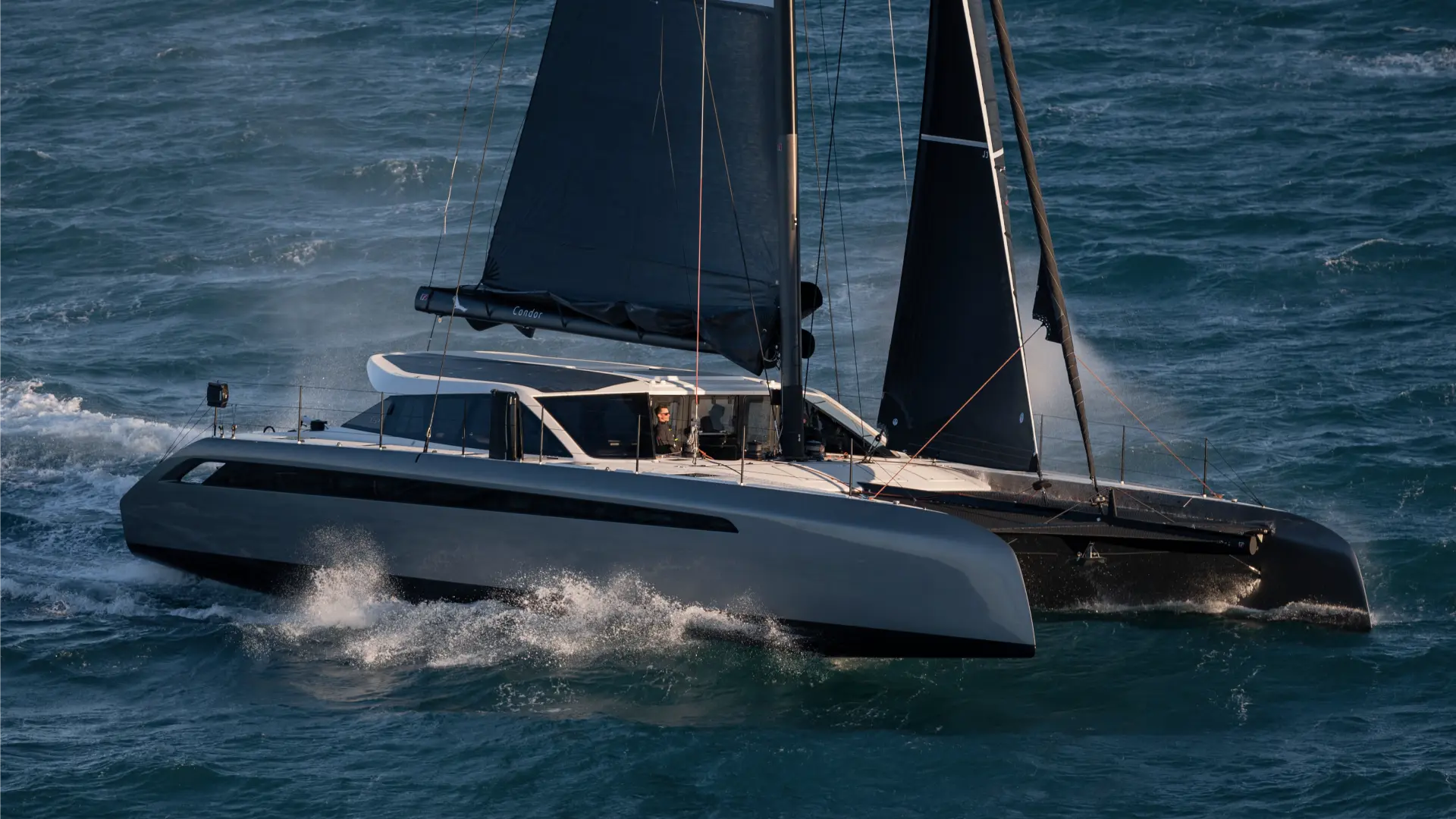
Everything so far applies to catamarans in general. Sailing a genuine performance catamaran is a further step change, and it comes down to three things.
• Daggerboards. Retractable boards generate lift and cut leeway, so the boat points high and tracks cleanly upwind - closer to a monohull's pointing ability, with a fraction of the drag when the boards are raised for shallow water.
• Carbon construction. An all-carbon platform is light and stiff, which means real acceleration and a connected, responsive feel more like a sporty monohull than a heavy cruiser.
• Sporty behaviour. The boat rewards active sailing. Trim matters, the helm talks to you, and the performance is there when you want it and calm when you don't.
This is not a niche pursuit reserved for racers. High-level sailors have chosen to cruise on performance catamarans precisely because they combine speed with liveaboard comfort - among them Loïck Peyron and John John Florence, whose Gunboat 48 Vela is a well-known example. It is the point where learning to sail a catamaran opens into a genuinely different way of being on the water.